Boltless Steel Shelving 500kg Per Shelf: Keyhole Assembly, Adjustable Levels, Main & Add-on
Most warehouse shelving decisions come down to three numbers: load per shelf, assembly time, and how easily the layout changes later. Boltless…
Most warehouse shelving decisions come down to three numbers: load per shelf, assembly time, and how easily the layout changes later. Boltless steel shelving with keyhole assembly is built for all three: 500 kg per shelf in the heavy duty class, tool-free assembly, and shelf heights that reposition in minutes. This page is the full spec sheet for the system we produce in Luoyang, Henan.
The keyhole assembly system
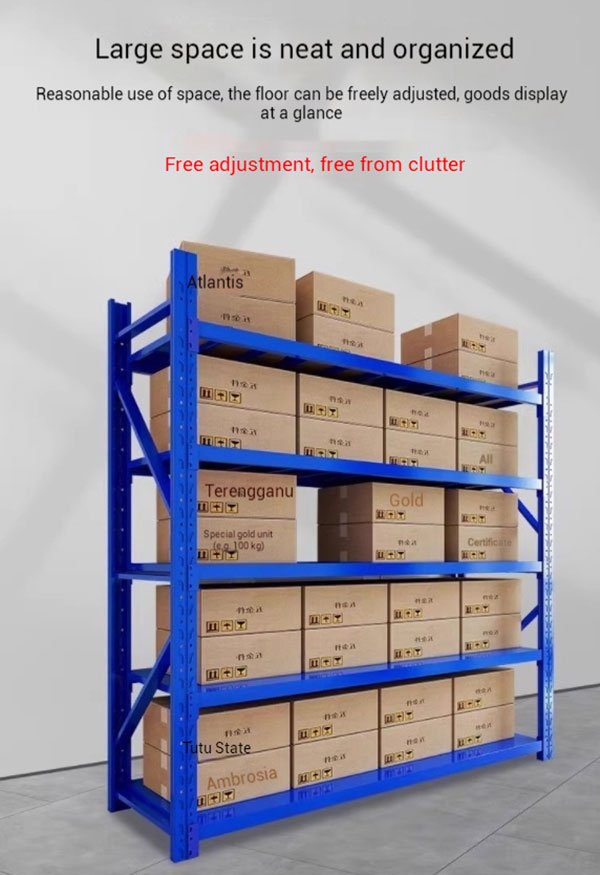
Boltless shelving gets its name from the connection method. Uprights are punched with keyhole-shaped slots at close spacing. Each beam ends in a hooked connector that slots into the keyhole and locks when pushed down. No bolts, no screws, no tools.
- Assembly speed. One person builds a standard unit in about five minutes after the first try; a warehouse crew assembles a full run in an afternoon
- Adjustment. Move a shelf level by lifting the beam out and slotting it into a different row of holes – height changes happen in seconds, not with a spanner
- Stability. The wedge-and-hook geometry tightens as load increases; the shelf locks harder under weight instead of loosening
Specifications
| Parameter | Spec |
|---|---|
| Load classes | 500 kg per shelf (heavy duty) / 300 kg per shelf (standard) |
| Shelf panel | Cold-rolled steel, 0.5 mm, reinforced with pressed ribs |
| Upright | Cold-rolled steel, 1.0 mm, keyhole-punched |
| Beams | 1.0 mm, double-C profile with three pressed wave ribs for stiffness |
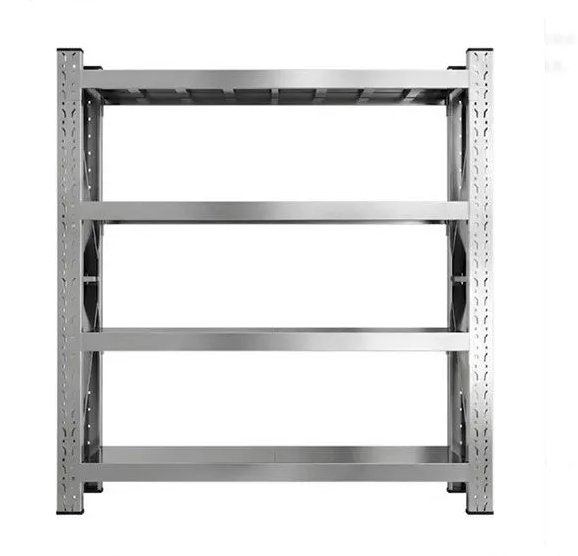
| Levels | 4–5 standard, height adjustable |
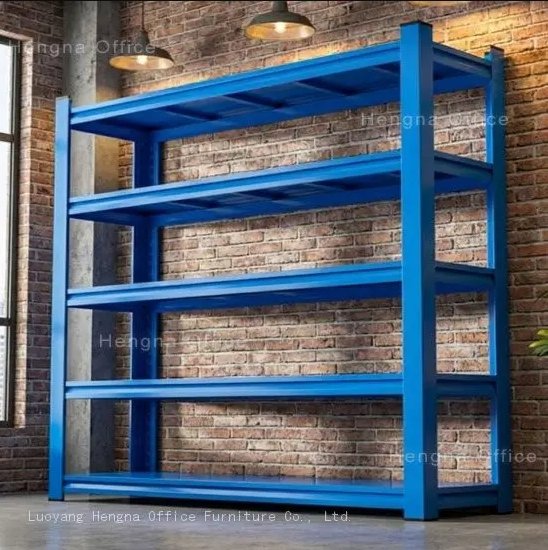
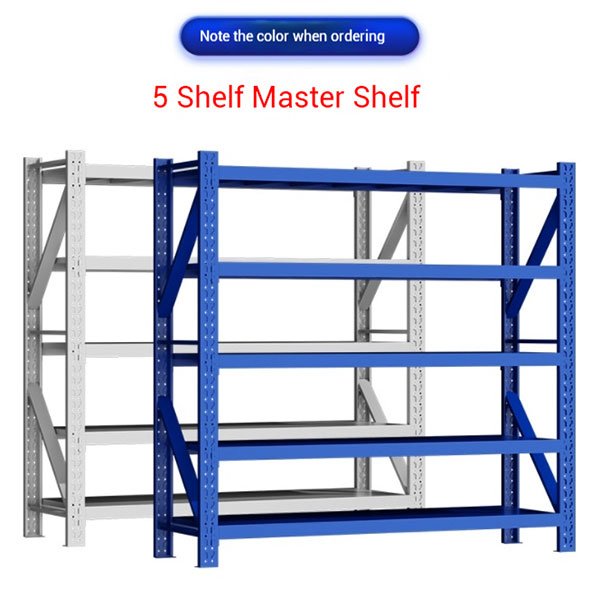
| Finish | Electrostatic powder coating; white, light gray, blue, black-yellow, military green, custom |
| Frames | Main frame (two uprights, standalone) + add-on frame (one upright, shares column with main) |
| Recommended working load | 200 kg per shelf for long service life |
Note the two load numbers: the 500 kg class is the structural rating, and the 200 kg working recommendation is what we suggest for daily warehouse use to keep the finish and hooks in good condition over years of loading cycles.
Main and add-on frames: how the system grows
A main frame is a complete unit with two uprights and stands alone. An add-on frame has one upright and shares the far column of the previous unit. Stringing main + add-on + add-on gives you a long continuous run while buying only one extra upright per bay.
- Starter warehouse: one main unit
- Expansion: add bays at roughly two-thirds the cost of the first bay
- Reconfiguration: unhook and re-slot to change the whole layout
Accessories that extend the system
- Wire mesh panels – flat or bordered, keep small cartons from falling off open shelves, also usable as shelf decks
- Lockable mesh doors – full-length rolling doors or per-level swing doors for secure storage areas
- Swivel casters – turn a unit into a mobile rack for picking carts or workshop use
- Adjustable leveling feet – plastic foot pads that level the unit on uneven floors and protect the floor surface
Where this shelving fits
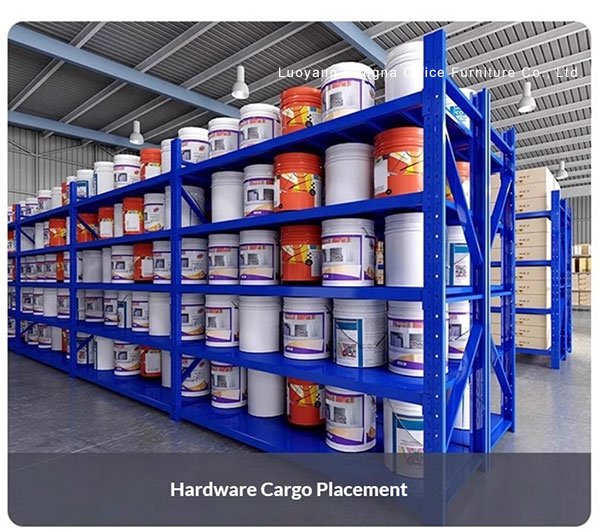
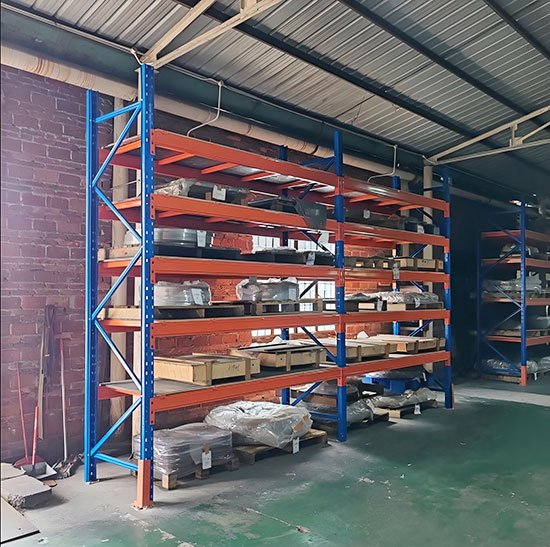
- Factories and workshops – paint drums, power tools, spare parts on 500 kg shelves
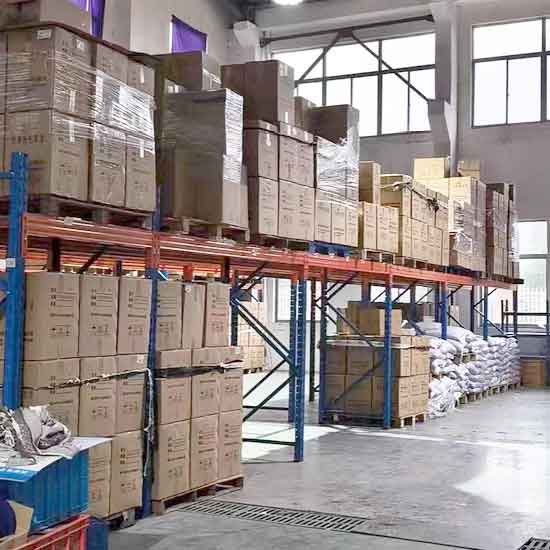
- Logistics and e-commerce centers – cartons and totes by SKU zone
- Retail and supermarkets – product display and backroom stock
- Schools and clinics – books, records, supplies
- Hardware stores and auto shops – circular saws, tool boxes, filters
- Home garages and offices – the light end of the range
Assembly walkthrough
The whole build is four steps and no tools:
- Step 1 – stand the uprights. Two uprights for a main frame, one for an add-on. Fit the leveling feet first if the floor is uneven
- Step 2 – hook the cross braces. Diagonal braces between the uprights lock into the same keyhole slots and give the frame its side-to-side rigidity
- Step 3 – set the beams. Hook beam tabs into the slot rows at your chosen heights and push down to seat. Check both ends are in the same row
- Step 4 – lay the shelf panels. Drop the panels onto the beam flanges; their pressed ribs sit into the beam profile so they do not slide
A single unit takes about five minutes once you have done one. A forty-bay warehouse run is a morning’s work for two people.
Choosing between the 300 kg and 500 kg class
The two classes look similar from five meters away; the difference is in beam wall thickness, shelf panel reinforcement, and the number of wave ribs pressed into the beam. The decision rule is simple:
- Store items under 200 kg per shelf – the 300 kg class does the job and costs less
- Store dense items or stacked cartons near 300 kg – step up to 500 kg; the margin keeps hooks and panels straight over years of loading cycles
- Anything on forklift-fed areas – 500 kg class, because a dropped pallet corner on a shelf edge should not bend the beam
Both classes interlock in the same run, so warehouses commonly buy heavy class for the bottom two levels and standard class above.
Colors and powder coating
Standard colors are white, light gray, blue, black, and black-yellow safety striping, with custom colors on request. The powder coating is applied over a pretreatment line – degreasing, phosphating, and rinsing – before electrostatic spraying and oven curing. That pretreatment is what stops rust starting under the coating at cut edges and punched holes, the two places cheap shelving fails first.
FAQ
How much weight does each shelf hold?
Two classes: 300 kg and 500 kg per shelf. Both come from the same keyhole frame family; the heavy class uses thicker beams and reinforced shelf panels.
Do I need tools to assemble it?
No. Beams hook into keyhole slots and lock by hand. A rubber mallet helps seat the hooks fully on the first build.
Can I move shelves after the unit is built?
Yes. Lift each beam out and hook it into another slot row. No disassembly required.
What is the difference between main and add-on frames?
A main frame stands alone with two uprights. An add-on frame has one upright and bolts to the previous unit, sharing its column. Add-on bays cost less and extend a run without gaps.
Can the shelving be used outdoors?
The powder coating handles humidity, but for full outdoor exposure or coastal salt air, choose the galvanized finish or step up to stainless steel – see the stainless steel shelving page for wet environments.
How many units can one container hold?
KD flat packing fits roughly 200–300 standard units per 40-foot container depending on size mix. We load by bay and mark bundles against the layout drawing, so unload crews build in order.
Can you match our brand colors?
Yes. The powder coating line runs custom colors per order. Agency colors, safety yellow, and two-tone runs are all standard requests.
What is the lead time for a container order?
Standard color runs ship in 2–3 weeks from confirmed order; custom colors and sizes add about a week. We confirm the loading plan before production so bay counts match the layout drawing.
Where the quality actually shows
The selling point of keyhole shelving is adjustment, and adjustment lives or dies on hole consistency. If slot rows drift by a millimeter between uprights, beams seat hard on one side and loose on the other. Our upright line punches through maintained dies with batch checks against the master gauge, and the test assembly on every production run verifies that beams drop into matching rows across all frames in the batch. That is the difference you feel the first time you re-slot a level – the beam moves and locks like every other one on the run.
Send your shelf count, load class, and color preference via the contact page for a factory quote with freight options.