Cantilever Rack for Solar Profile Storage — Long-Span PV Mounting Racks for Extrusion Plants
Factories that make solar mounting structures, aluminum extrusions, or long steel pipe share a storage headache that box shelving cannot solve. The…
Factories that make solar mounting structures, aluminum extrusions, or long steel pipe share a storage headache that box shelving cannot solve. The product is long, straight, and heavy, and it has to be stored without bending, scratching, or burying one batch behind another. Traditional racking with uprights on both sides simply gets in the way of a long part.
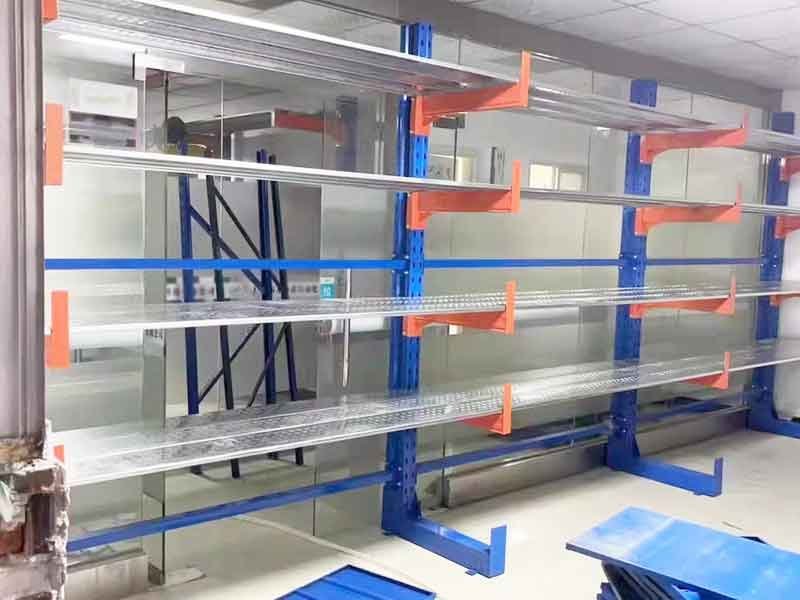
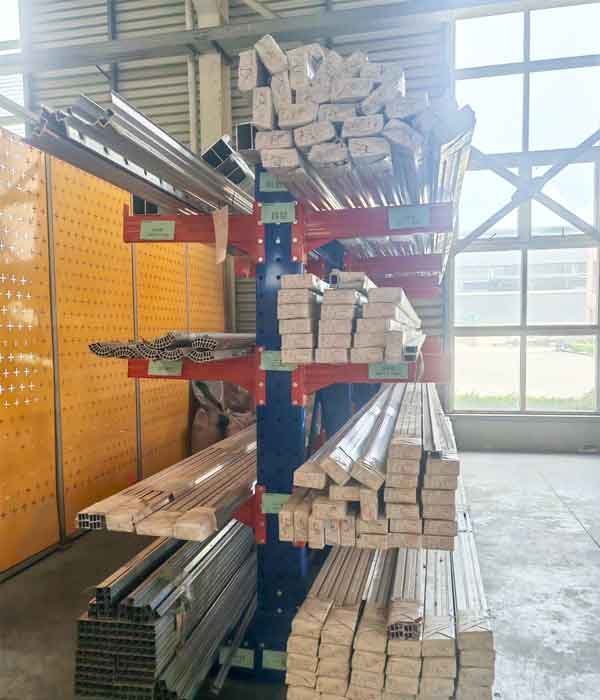
Cantilever rack for solar profile storage is the classic answer. It uses a row of upright columns with horizontal arms reaching out on one side, so long beams and profiles rest on the arms with nothing blocking their full length. Here is how to choose a cantilever system for PV mounting, wind, and structural steel production.
Why cantilever racks fit long material
A cantilever rack has no front uprights. Instead, columns sit at intervals along a single line, and arms extend from the column face. Loads sit on the arms, running the full length of the row. That open front means a forklift or overhead crane can set a 6-meter beam down along the arms without threading it between uprights or lifting it over a frame.
This layout suits solar PV mounting factories, where aluminum rails, steel purlins, and mounting profiles arrive in fixed lengths. Instead of stacking long bundles on the floor — where they get scratched and hard to sort — the rack holds each length class on its own arm level, visible and reachable.
Matching arm capacity to your heaviest bundle
Arm load is the first spec to settle. A single arm on a medium cantilever rack may carry several hundred kilograms, and a heavy-duty arm more. The number of arms per column and the arm length determine how much long material a bay holds. For PV mounting and structural sections, confirm the arm rating against your heaviest bundle, and size the arm length so the bundle sits fully supported without overhang that could sag.
| Spec point | What to check |
|---|---|
| Arm load rating | Must exceed the weight of the heaviest bundle you place on one arm |
| Arm length | Support the full width of the material; avoid long unsupported overhang |
| Column spacing | Set intervals so long material rests on at least two arms without bowing |
| Level spacing | Plan vertical gaps for the thickest bundle, with room to lift it in and out |
| Surface protection | Confirm arm pads or coating that will not scratch finished profiles |
Storing PV aluminum profiles without damage
PV mounting profiles are usually anodized or painted aluminum, and a scratch is a quality defect. A cantilever rack protects them two ways: the open front avoids drag across a frame, and arm surfaces can be fitted with protective padding so the extrusion does not sit directly on bare steel. Bundles are placed once and picked by length class, which keeps surface finish intact and speeds up line feeding.
Beyond solar: wind and structural steel
The same rack principle applies wherever long parts are stored. A long-span cantilever rack scales to wind energy and structural steel plants, where tower sections, flanges, beams, and plates move through the shop in long lengths. In these settings the rack often works alongside a steel plate rack or a dedicated long-span system, with arms sized for heavier sections and column spacing matched to the parts on the line.
Single-sided or double-sided layout
Cantilever racks come in single-sided and double-sided forms:
- Single-sided — arms on one face, usually placed against a wall or as a back-to-back run. Good for storing one length family along a wall.
- Double-sided — arms on both faces of the columns, with an aisle down the middle. Doubles capacity per row and suits open-floor layout.
For a PV plant with several length classes in continuous production, a double-sided row lets you keep two material families in one footprint, each reached from its own aisle.
Planning your cantilever layout
Before ordering, settle these points:
- List the length classes you store and the number of bundles of each.
- Total the weight of the heaviest bundle to fix the arm rating.
- Measure aisle width for your forklift or crane so it can approach the arms with a full load.
- Decide single- vs double-sided and the number of levels per column.
- Confirm protective arm pads and powder-coat color with the supplier.
Accessories that keep the row organized
Arm accessories make a cantilever system easier to run. Pipe stops, retainers, and dividers hold round or rolled material in place and stop it rolling off the arms. Arm pads protect finished surfaces, and level dividers help separate different profiles within one bay. If you handle both long beams and shorter cut-offs, a mixed level plan — long arms on lower levels, shorter sections above — keeps the row organized and speeds up line feeding.
Common mistakes to avoid
Three errors show up on cantilever projects. First, buyers size the arm for an average bundle instead of the heaviest one, and the arm bows under load. Second, they skip protective pads on finished aluminum, then find scratches on every anodized extrusion. Third, they space columns too far apart, so a long bundle rests on only one arm and sags in the middle. Size the arm for the heaviest bundle, fit protective pads, and keep column spacing within the rated support length, and the row holds up for years.
Why buy from Luoyang Hengna
Luoyang Hengna Office is a steel furniture manufacturer in the Pangcun steel furniture industrial zone, Henan, China. We build cantilever racks factory-direct for solar, wind, and structural steel storage, with arm ratings and column spacing sized to your material list. Export orders ship in knock-down form with protective packaging, and pricing is confirmed per project with a 24-hour quotation response.
Frequently asked questions
How much weight can a cantilever rack arm hold?
Arm ratings range from light to heavy duty. Confirm the rating for the model you choose and size it against the heaviest bundle you place on a single arm.
Can cantilever racks store finished aluminum profiles safely?
Yes. With protective arm pads, finished anodized or painted profiles rest without direct steel contact, avoiding scratches.
Do I need a forklift or an overhead crane for a cantilever rack?
Both work. The open front lets a forklift drive in or a crane lower long bundles directly onto the arms. Choose based on your existing handling equipment.
Can the rack be expanded as production grows?
Yes. Cantilever systems are typically expandable — you can add columns, arms, and levels to an existing run, matching frame specs.
How does a cantilever rack ship overseas?
It ships in knock-down form, flat-packed and protected, and assembles on site. Freight terms and lead time are confirmed in the quotation.
Get a quote within 24 hours
If you are setting up long-material storage for solar, wind, or structural steel, contact Luoyang Hengna for a quotation. We respond within 24 hours with pricing, lead time, and shipping options based on your material list and destination.