How to Solve Heavy-Duty Racking Load Capacity Issues: Hot-Rolled vs. Cold-Rolled Steel Guide
In the high-stakes world of global logistics and industrial warehousing, your racking system is the backbone of your operation. However, a common…
In the high-stakes world of global logistics and industrial warehousing, your racking system is the backbone of your operation. However, a common and dangerous “silent killer” in the warehouse is insufficient load capacity.
When a heavy-duty pallet rack fails to meet its weight requirements, the consequences range from minor beam deflection to catastrophic structural collapse, leading to inventory loss, operational downtime, and severe safety liabilities.
If you are asking, “Why is my racking failing?” or “How do I choose the right steel for my next expansion?”—this guide provides the technical clarity you need. We will dive deep into the metallurgy of Hot-Rolled (HR) vs. Cold-Rolled (CR) steel and provide a roadmap to fixing capacity issues.
1. Heavy-Duty Racking Load Capacity Defining the Core: What Makes a Rack “Heavy-Duty”?
In Western markets (following RMI, ANSI, or SEMA standards), “heavy-duty” typically refers to systems capable of supporting 1,000kg to over 3,000kg (2,200lbs to 6,600lbs) per pallet position.
The structural integrity of these systems relies entirely on two factors: Engineering Design and Material Science.

Hot-Rolled Steel (Structural Steel)
Hot-rolled steel is processed at extremely high temperatures (above 1,700°F), which is above the steel’s recrystallization temperature.
- The Result: A material that is incredibly resilient, ductile, and resistant to impact.
- Application: Used in “Structural Racking.” It features thicker walls and is the gold standard for high-traffic environments or heavy-load capacities.
Cold-Rolled Steel (Roll-Formed Steel)
Cold-rolled steel is processed at room temperature. It is thinned out and shaped into complex “C” or “Omega” profiles.
- The Result: High dimensional precision and a smooth finish, but thinner walls.
- Application: Used in “Roll-Formed Racking.” It is cost-effective and suitable for light-to-medium heavy loads but is more susceptible to forklift impact damage.
2. Comparison: Hot-Rolled vs. Cold-Rolled Steel for Racking
| Feature | Hot-Rolled (Structural) Steel | Cold-Rolled (Roll-Formed) Steel |
| Manufacturing | Pressed while red-hot | Bent at room temperature |
| Wall Thickness | Typically 3mm – 5mm+ | Typically 1.5mm – 2.5mm |
| Impact Resistance | Extremely high (forklift resistant) | Lower (prone to denting/buckling) |
| Load Capacity | Superior for massive, static loads | Good for standard uniform loads |
| Durability | Decades; handles seismic zones well | Standard; requires more protection |
| Cost | Higher initial investment | Lower initial cost |
3. Why Your Racking May Be Underperforming
If you are experiencing “insufficient load capacity,” it is rarely a single-factor failure. Here are the primary culprits:
A. Material Mismatch
Many facilities mistakenly install roll-formed (cold-rolled) racking for applications that require structural (hot-rolled) strength. While cold-rolled steel is excellent for standard retail distribution, it may struggle with the concentrated, heavy loads of the automotive or heavy machinery industries.
B. Deflection vs. Permanent Deformation
Under Western standards (like the Rack Manufacturers Institute – RMI), a beam is allowed a certain amount of “deflection” (sagging) under load. However, if the steel is poor quality or the gauge is too thin, that deflection becomes permanent deformation, indicating the steel has surpassed its yield point.
C. Fatigue and “Hidden” Overloading
Steel has a memory. Repeatedly loading a rack to its absolute limit causes microscopic stress fractures over time. If your rack was designed for 1,000kg and you consistently hit 1,050kg, the structural integrity is slowly degrading.
4. How to Fix Insufficient Load Capacity: A Step-by-Step Guide
If you suspect your current system is unsafe or under-capacity, follow these professional remediation steps:
Step 1: Conduct a Professional Rack Audit
Don’t guess. Hire a certified inspector to perform a “Load Capacity Verification.” They will check the thickness of the steel (gauge), the bolt grades, and the weld integrity.
Tip: Look for the Load Warning Plaque. If it’s missing, you are already out of compliance with OSHA/HSE standards.
Step 2: Retrofit with Structural Components
You don’t always need to tear down the whole warehouse.
- Replace Beams: Switch to heavy-duty hot-rolled structural beams with “bolted” connections rather than “teardrop” clip-ins.
- Add Reinforcement: Install upright protectors and column boosters to the bottom 12-24 inches of the frames, where 80% of structural failures occur.
Step 3: Upgrade Material Quality
If you are building new or replacing sections, specify ASTM A36 (Structural Steel) or its European equivalent S235JR/S355JR. These hot-rolled grades offer predictable yield strengths that ensure your calculated load capacity has a 1.65 to 2.0 safety factor.
Step 4: Validate the Floor/Slab Capacity
The rack is only as strong as the ground it sits on. Heavy-duty structural racking concentrates immense pressure on a small “footprint.” Ensure your concrete slab can handle the KIPS (kilopounds) per square inch exerted by the upright baseplates.
5. The Business Case: Why Quality Steel Saves Money
While hot-rolled structural steel has a higher upfront cost (approx. 20-40% more than cold-rolled), the Total Cost of Ownership (TCO) is lower in heavy-duty environments:
- Lower Maintenance: Structural steel can withstand forklift impacts that would crumple cold-rolled uprights.
- Higher Resale Value: Structural racking holds its value better in the secondary market.
- Future-Proofing: Higher load capacities allow you to change your product mix (e.g., moving from light electronics to heavy batteries) without replacing your infrastructure.
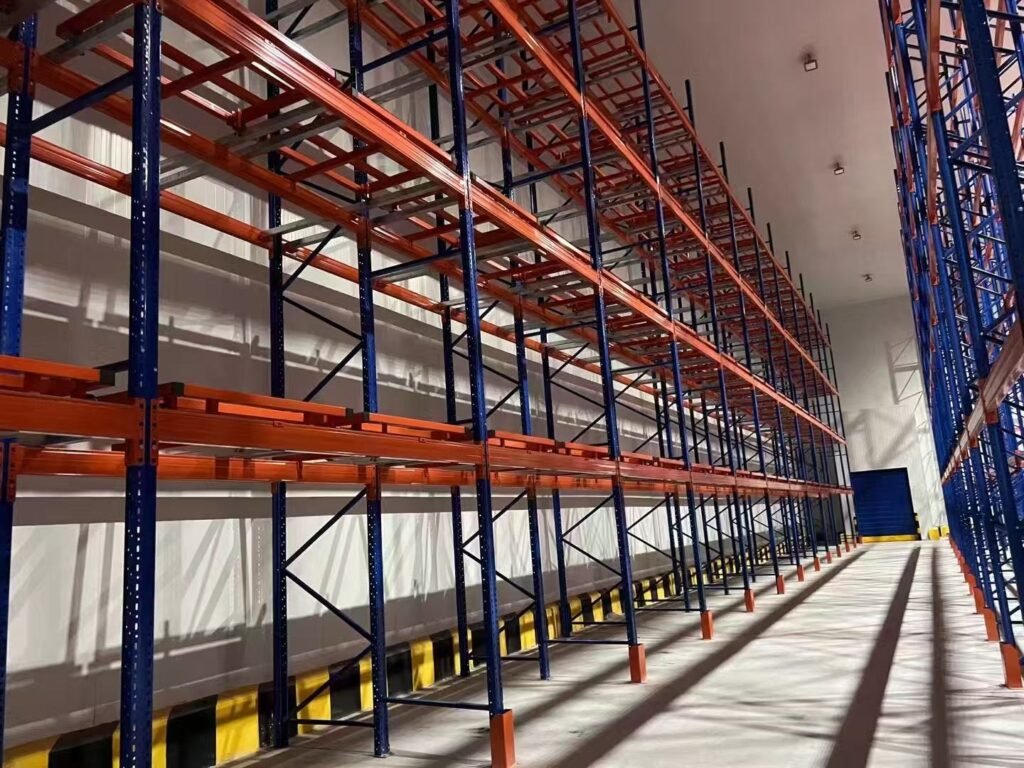
6. Case Study: Logistics Optimization
The Challenge: A machinery distributor in Germany used cold-rolled “teardrop” racking. Within two years, 30% of the beams showed permanent sagging (deflection > L/180), and uprights were frequently damaged by heavy reach trucks.
The Solution: The facility transitioned to a Hot-Rolled Structural System.
- Result 1: Load capacity increased from 900kg to 1,800kg per level.
- Result 2: Rack repair costs dropped by 85% annually.
- Result 3: Compliance with EN 15512 safety standards was achieved, lowering insurance premiums.
Don’t Compromise on Structural Integrity
Addressing heavy-duty pallet racking load capacity is not just about “adding more steel”—it is about adding the right kind of steel. While cold-rolled steel has its place in modern warehousing, hot-rolled structural steel is the undisputed king of heavy-duty, high-safety environments.